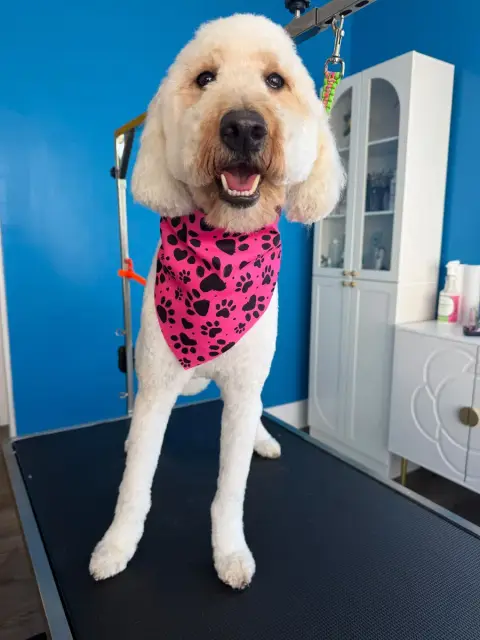
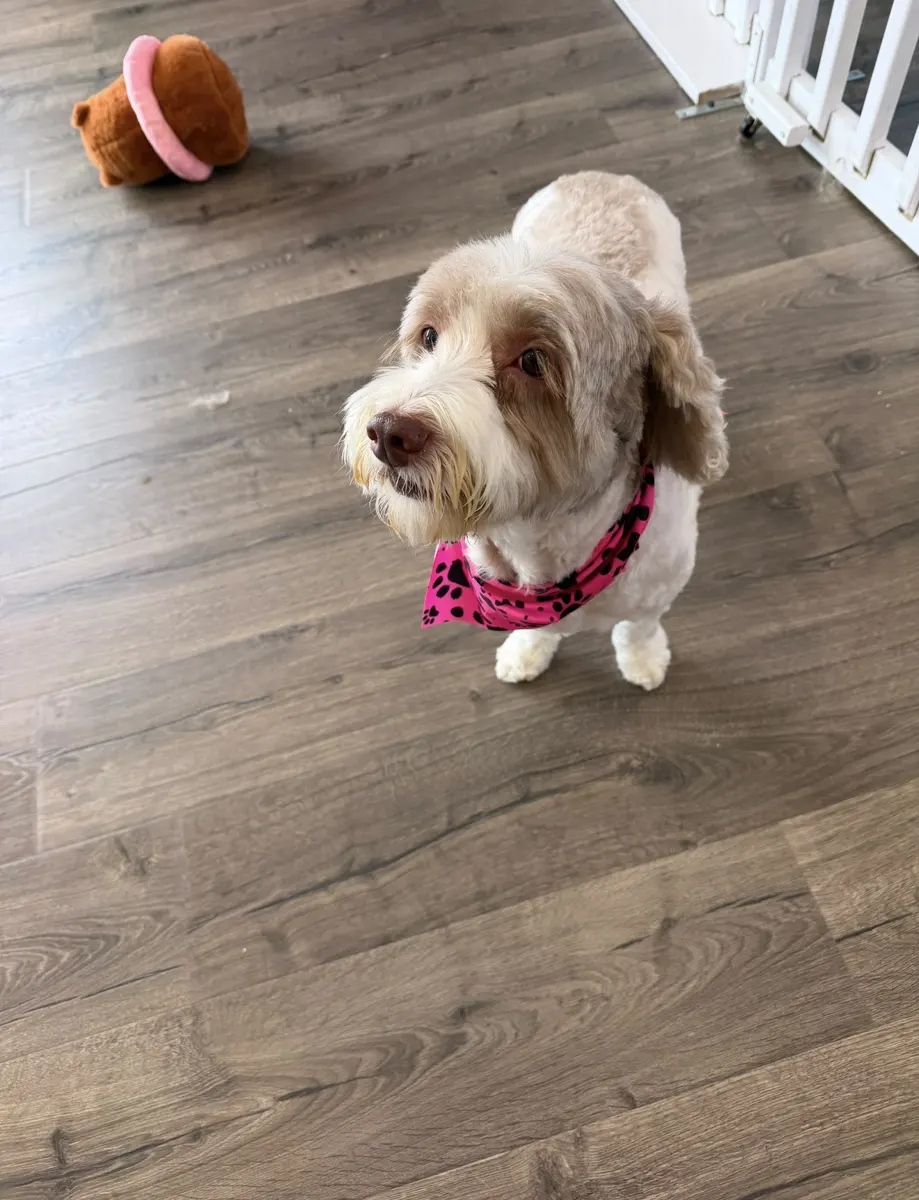
A mat is a dense clump of tangled hair, usually made of shed undercoat and live hair twisted together. Once it forms, it tends to grow, pulling in more hair and getting tighter against the skin. Matting is one of the most common grooming problems we see, especially in doodles, poodle mixes, spaniels and long-coated small breeds.
What causes matting
Mats start where hair moves, rubs or stays damp. The usual causes:
- Loose hair that does not fall out. Low-shedding coats hold onto dead hair, which wraps around live hair.
- Friction. Collars, harnesses, sweaters and the spot where the legs rub the body.
- Moisture. Swimming, rain, snow and baths that are left to air dry without brushing.
- Brushing only the top layer. The coat looks fluffy on the surface while tangles build up underneath.
- Long styles without enough brushing. The longer the coat, the more brushing it needs.
Where to check first
| Area | Why it mats |
|---|---|
| Behind the ears | Fine, soft hair and frequent scratching |
| Ears themselves (spaniels, doodles) | Long feathering that drags and gets wet |
| Collar and harness line | Constant rubbing |
| Armpits and inner legs | Friction with every step |
| Belly and groin | Moisture and lying down |
| Tail and rear | Soiling and sitting |
| Paws and between pads | Snow, mud and moisture |
How to tell a tangle from a mat
Run a metal comb through the coat all the way to the skin. If it glides through, the coat is fine. If it catches but you can gently tease it apart with your fingers, that is a tangle you can usually handle. If the comb cannot get in at all, or you feel a hard, flat pad of hair against the skin, that is a mat, and it is time to stop.
What you can safely do at home
For small, loose tangles:
- Work on a dry coat. Water tightens mats. Use a detangling or conditioning spray made for dogs.
- Hold the hair at the base, between the tangle and the skin, so the brushing pulls on your fingers and not on your dog.
- Separate with your fingers first. Pull the tangle apart into smaller pieces.
- Use a slicker brush in short strokes from the outer edge of the tangle inward.
- Finish with a metal comb to make sure you can reach the skin.
- Take breaks. A few minutes at a time, with treats, is better than one long struggle.
Our guide to brushing your dog at home covers line brushing, the technique that prevents most mats in the first place.
What not to do
- Do not cut mats out with scissors. Skin gets pulled up into the mat and is very easy to cut.
- Do not bathe a matted dog and hope it loosens. It usually gets worse.
- Do not keep working on a spot if your dog yelps, flinches or tries to bite. That area hurts.
- Do not leave a mat “for later” under a sweater or harness. It will grow.
How a groomer handles matting
At the salon, the groomer first checks how widespread and how tight the matting is, and how your dog is handling being touched there. From there, there are generally two paths.
Dematting (brushing out)
When mats are limited and the dog tolerates it, the groomer works them out with tools and products designed for it. This saves length, which matters to owners who love a fluffy look. It takes time and patience, which is why dematting at Stardog Grooming is priced at $65 per hour. One customer, Heather C., wrote that her dog Violet “had some tricky matting on her ears. Stardog was able to remove the matts without cutting too much hair off.”
Shaving short (a “shave-down”)
When matting is tight, close to the skin or all over the body, brushing it out would be painful and stressful for the dog. In those cases, clipping the coat short underneath the mats is the humane choice. The coat grows back, and you get a fresh start. It can be disappointing, but it is better for your dog than hours of pulling.
What may be under the mats
Mats hide the skin. Once they are removed, it is common to find redness, irritation, or skin that has been trapped and damp. If the groomer notices sores, signs of infection, parasites or anything unusual, they will tell you, and you should follow up with your veterinarian. Grooming removes the mats; it does not treat skin conditions. If fleas or ticks are found, flea and tick treatment is required (an extra $35, see our policies).
Preventing mats from coming back
- Brush to the skin several times a week, more for long or curly coats
- Pay special attention to the “hot spots” in the table above
- Dry and brush the coat after swimming, rain or snow
- Take collars and harnesses off at home when it is safe to do so
- Keep a regular grooming schedule; for doodles that is usually every 4 to 6 weeks
- Consider a shorter style if long coat maintenance is not realistic for your household
A coat treatment can also help. Our keratin coat treatment is a conditioning add-on for coats that feel dry or rough. For doodle-specific tips, read doodle coat care between grooms.
When to book a groomer
Book a dematting appointment, or a full groom with dematting, if you find mats your comb cannot reach through, if your dog is sore when touched in one spot, or if matting covers more than a few small areas. Dematting is a “Request to Book” service, so the team can plan enough time. Full grooms are priced by size; see our pricing page, and for a medium doodle, the medium dog full groom is the usual starting point. If you notice skin wounds, a bad smell or signs of pain, see your veterinarian first.
Frequently asked questions
Do mats hurt dogs?
They can. Tight mats pull on the skin every time the dog moves, trap moisture and dirt, and can hide redness or sores underneath.
Can I use scissors to cut out a mat?
Please don't. Mats sit right against the skin, and it is very easy to cut the skin along with the hair. Clippers in a groomer's hands are much safer.
Will my dog's coat grow back after a shave-down?
Curly and wavy coats like doodles and poodles generally grow back well. Double-coated breeds can be different, which is one reason to keep them brushed so a shave is never needed.
How long does dematting take?
It depends on how many mats there are, how tight they are and how well the dog tolerates it. That is why dematting is usually charged by the hour.
Does a bath help with mats?
No, a bath before brushing usually makes mats tighter. Mats should be brushed out or removed before or during the bath, then the coat is dried and brushed straight.